Battery storage to revolutionise electricity infrastructure
Ausconnex, part of the Endeavour Energy Group, is planning to install Battery Energy Storage Systems, across Greater Western Sydney.
A BESS captures and stores electricity from renewable and non-renewable sources in commercial sized batteries. It releases this stored power when needed to meet energy demand, including during peak periods.
This initiative supports the upgrade to the existing electricity grid through the growth of renewable energy sources and will help deliver safer, cleaner and more reliable power contributing to the NSW Government’s goal of reaching net zero emissions by 2050.


Planned Battery Energy Storage System in Penrith
Ausconnex is proposing a high voltage (HV) BESS and a medium voltage (MV) BESS, both of which will be located adjacent to the existing substation at 2235-2249 Castlereagh Road, Penrith. A BESS is a type of energy storage that captures energy from renewable and non-renewable sources and uses batteries to store and distribute electricity.
Having the BESS located adjacent to the existing transmission substation minimises environmental impacts by colocating energy transmission and energy storage infrastructure and maximises land use efficiency.
The proposed MV BESS will have capacity to supply up to 5 megawatts (MW) of power and store up to 10MWh (megawatts hour) of energy. The proposed HV BESS, in comparison, will have a capacity to supply up to 100 megawatts of power and store 200MWh of energy.
Regulatory and environmental approvals
The proposed HV BESS and MV BESS require separate planning and environmental approval processes due to their development classifications.
HV BESS
As a State Significant Development (SSD), the proposed HV BESS requires an Environmental Impact Statement (EIS) lodged to the Department of Planning, Housing and Infrastructure (DPHI), and approval to be determined by the NSW Planning Minister.
The EIS for the Penrith HV BESS was placed on public exhibition between Tuesday 2 December 2025 and Wednesday 21 January 2026. During public exhibition, the community were invited to read the EIS document, seek clarification on content and provide feedback directly to the DPHI via formal submission on the Penrith HV BESS Major Projects Portal.
View the EIS
DPHI is currently reviewing submission from the public exhibition period, and over the coming weeks Ausconnex will prepare responses to all matters raised and publish a Submissions Report.
Ausconnex acknowledges the collective sentiment of submissions received are used by DPHI to guide the final determination, as well as any conditions of approval for the project.
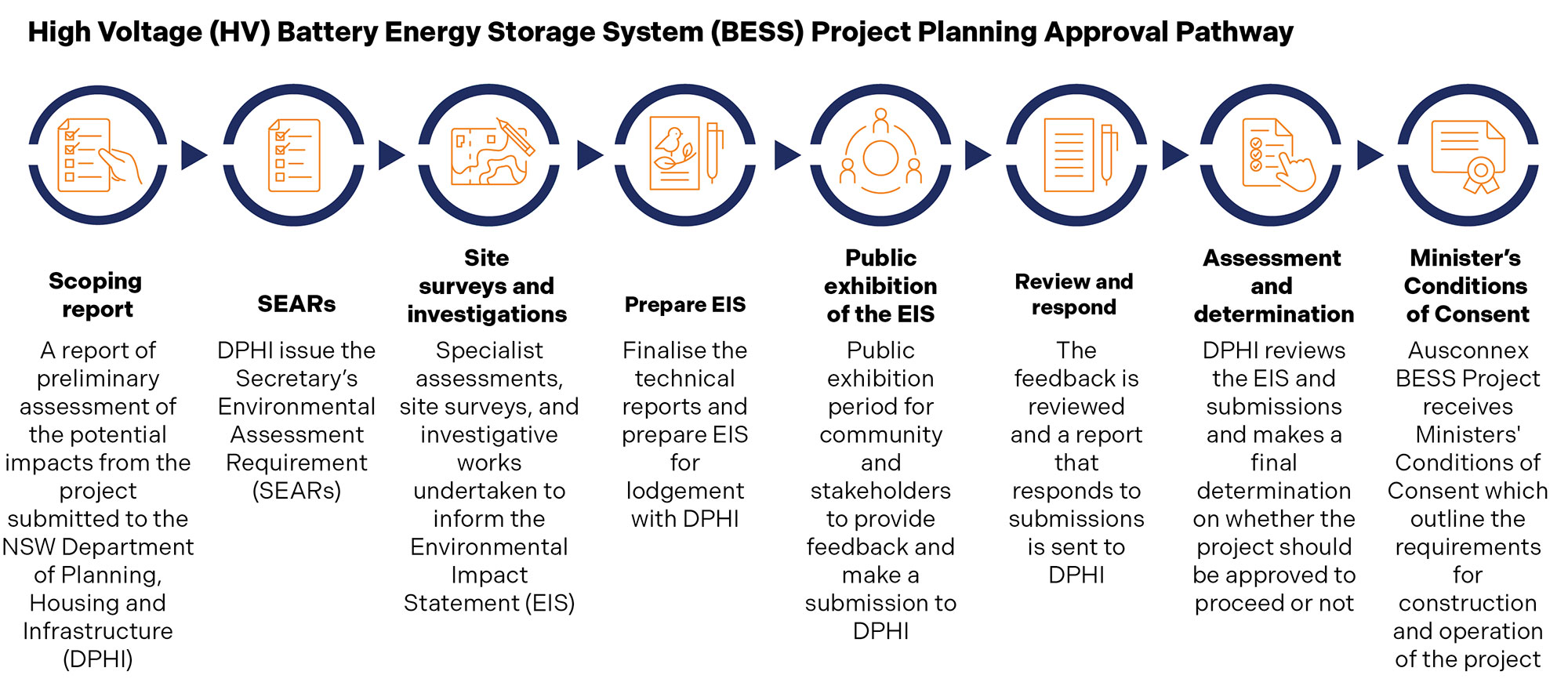
The Penrith HV BESS EIS planning pathway
MV BESS
The MV BESS, classified as a Regionally Significant Development, followed a Development Assessment (DA) approval process overseen by Penrith City Council and determined by the Local Planning Panel. The DA for the MV BESS was submitted to Council in May 2025 and approval was received in February 2026.
Next steps (pending approvals)
Following approval from the relevant State and Planning authorities, construction of the HV BESS and MV BESS is expected to begin in late 2026 and be completed by 2028.
The Ausconnex project team remain available to any interested stakeholders and community members to discuss both the HV and MV BESS projects.
Contact the project team
As a valued community member, we invite you to ask questions or share your feedback on the project following the approval of the Development Application (DA) with Penrith City Council in February 2026. We will continue to keep you updated throughout the project.
Please contact us at batteries@ausconnex.com.au or 1800 955 224 if you would like to make any comments on the proposed project at this stage.
BESS stands for Battery Energy Storage System, as it consists of one or more batteries that store electrical energy for use at a later time. This stored energy can then be drawn upon as needed, to meet various demands for power.
The proposed BESS will provide localised energy supply, support the growing demand in energy resources, and;
- Provide reliable power supply to customers now and in the future;
- Improve service reliability and provide grid support by reducing the risk of power disruptions;
- Support the energy network benefiting customers and enabling improved grid resiliency and;
- Enhance the energy sustainability ecosystem by storing excess solar generation.
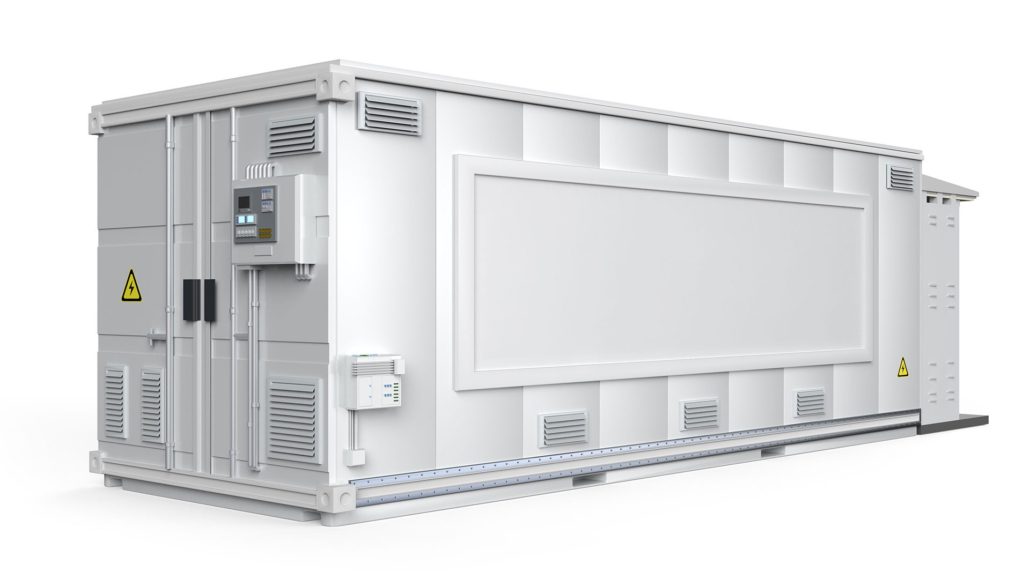
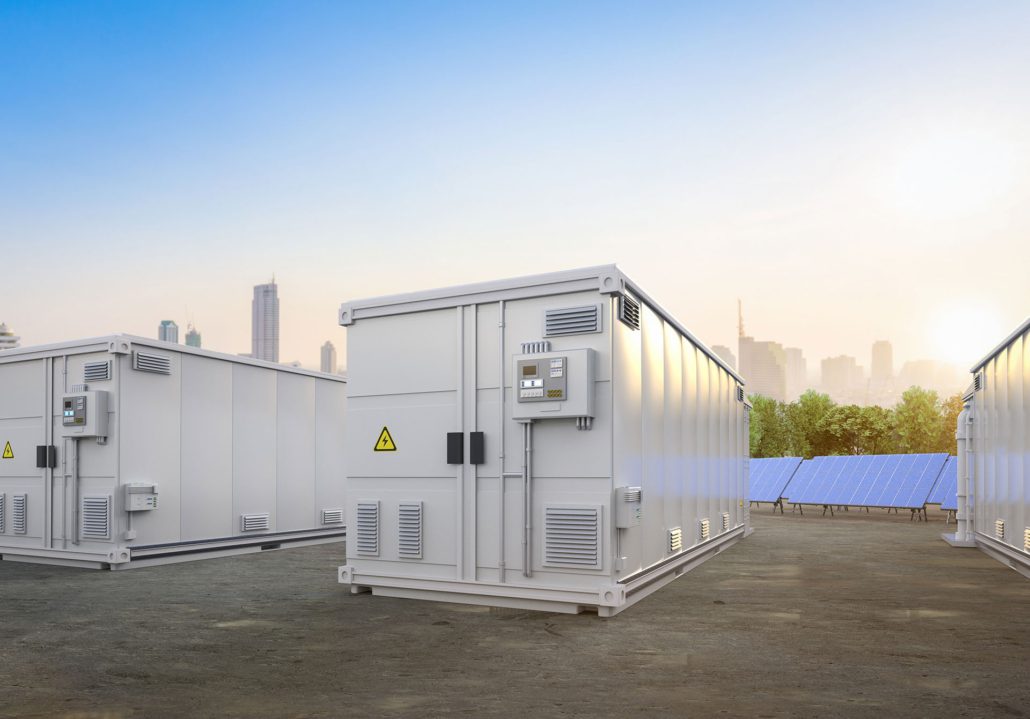
A BESS, which generally looks like a set of shipping containers that are about three metres high, is comprised of four key components:
- Battery packs – a set of modules that turn chemical energy into electricity, which, in turn, make up the battery pack. There will be four battery units within the Penrith MV BESS site and 48 within the Penrith HV BESS site.
- Battery management system – BMS: Which ensures the safety of the battery system by monitoring and measuring the condition of the modules.
- Inverter or power conversion system – PCS: Which shifts the direct current (DC) generated by the batteries to alternating current (AC) that goes into the electricity grid and vice versa, allowing for charging and discharging.
- Balance of Plant – BoP: Which is the electrical equipment enabling connecting the BESS to the grid including transformers, switchgear and cables.
The BESS proposed at Penrith may be partially visible from the street, however, the surrounding industrial and other existing built structures and vegetation screening would limit visibility of the proposed infrastructure.
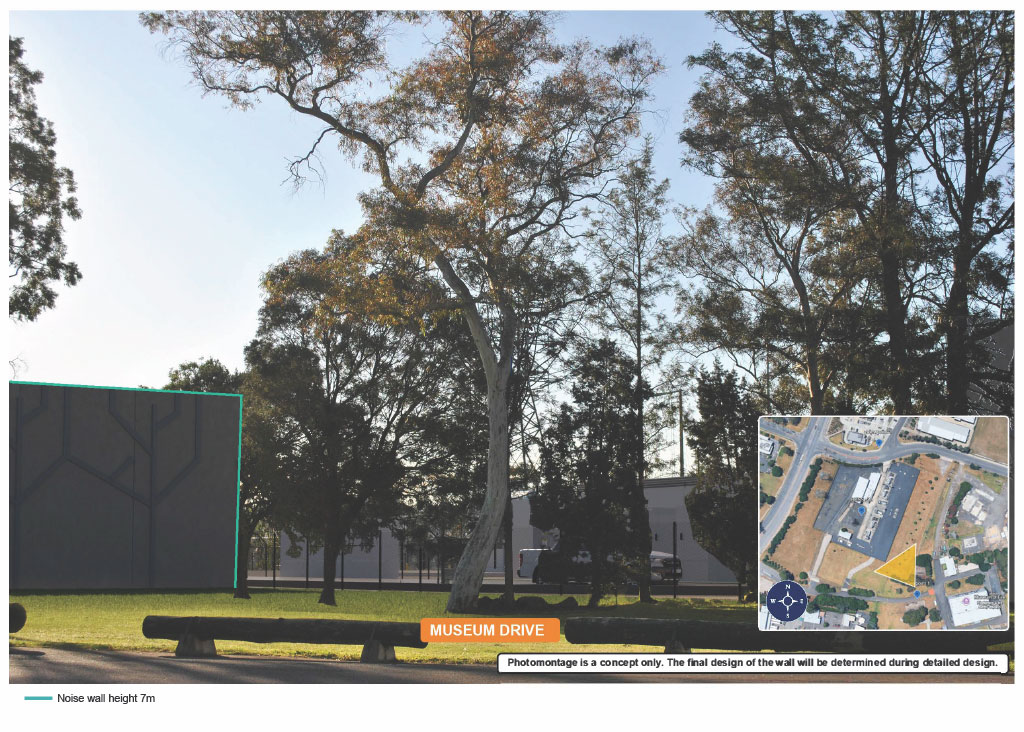
Penrith BESS photomontages
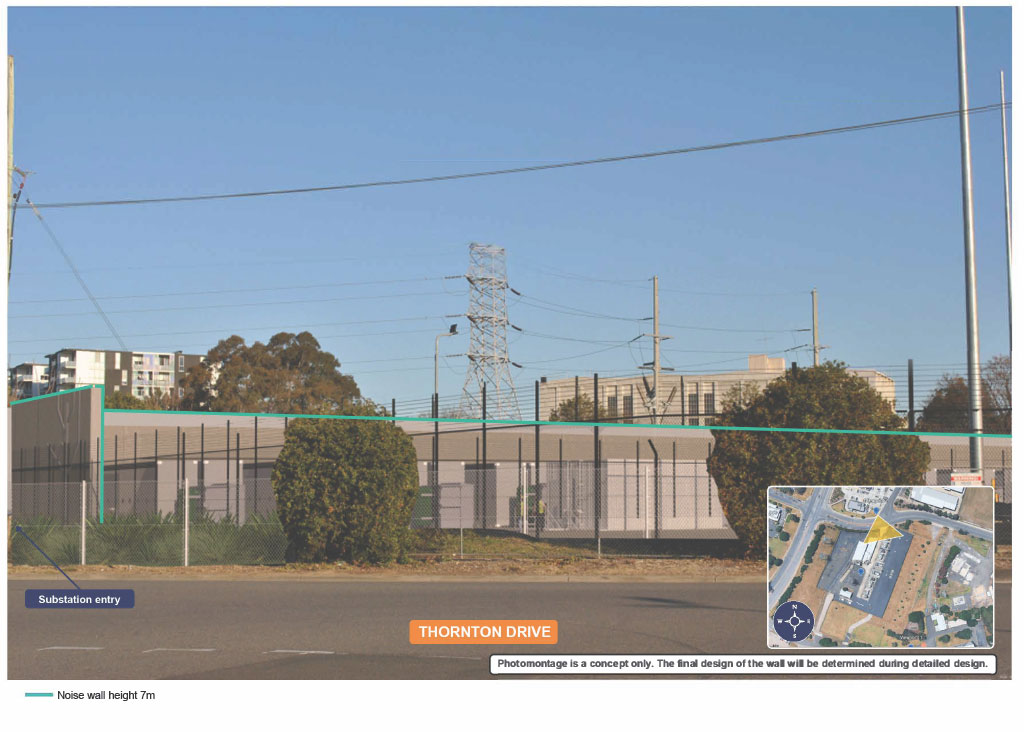
Photomontages are computer generated images that provide an example of what the project may look like when complete. The Ausconnex project team creates them by overlaying a 3D model of the proposed BESS development onto photographs from the surrounding areas to the project.
Please note, the photomontages are based on the concept design as at late 2025 and are subject to change. Final project design will be determined during the detailed design phase, commencing early 2026.
View the photomontages below:
Photomontage: View from Museum Drive
Photomontage: View from Thornton Drive
- Grid reliability and stabilisation – the BESS can absorb or release electrical power almost instantly, providing valuable services in balancing power supply and demand.
- Renewable energy integration – a BESS can store excess energy generated from renewable sources like solar during periods of low demand and release it during peak demand times. Ensuring a continuous and reliable supply of renewable energy even when the sun isn’t shining.
- Flexibility to dispatch energy – During natural disasters or heat waves when the grid is under stress, the BESS will be able to provide grid support, enhancing resilience to ensure the power stays on.
- Cost efficiencies – by discharging stored energy during peak demand periods, the BESS can help reduce the need for expensive peaking power plants, leading to potential cost savings for consumers on their power bills.
- Environmental benefits – by integrating renewable energy more effectively and decreasing dependence on fossil fuel-based peaking plants, BESS contributes to lower carbon emissions and a cleaner environment.
Will the BESS generate an electric and magnetic field?
Electromagnetic Fields (EMF) are created whenever there is a difference in voltage (which forms electric fields) or when electricity flows through wires or devices (which forms magnetic fields). Construction of the BESS will follow strict Australian safety standards and guidelines, ensuring it operates safely and effectively. The EMF levels are expected to be very low and within safe limits.
To further ensure safety, we will conduct detailed assessments of the potential impacts on nearby areas and sensitive locations as part of the Environmental Impact Statement (EIS). This assessment will help us understand and mitigate any possible risks related to EMF exposure.
What are the possible fire risks for grid-scale batteries?
The design and installation of the BESS will follow Australian safety standards and comply with the Work Health and Safety Regulation 2025. An advanced Battery Management System will ensure operation is within safe limits and will be supported by an array of sensors and fire suppression systems to reduce fire risks. Full scale fire testing will be completed to ensure adequate separation between the BESS and other infrastructure. Fire & Rescue NSW will be engaged as part of developing an appropriate emergency response plan to a fire.
How much noise will the BESS generate once operational?
Once the BESS is up and running, it will meet all industry noise standards. The sound you might hear will come from normal day-to-day operation and maintenance. We’ve undertaken a Noise and Vibration Assessment which includes recommendations to reduce noise, and we’ll put measures in place to reduce impacts to the community. A common noise mitigation measure is the installation of noise walls. The need for noise walls is currently being investigated as part of the planning process.
Will there be a lot of noise and dust during construction?
Construction will take place on weekdays from 7am to 6pm and on Saturdays from 8am to 1pm. We’re currently assessing the noise levels from equipment and activities during construction. If the assessment shows that noise reduction measures are needed, we’ll put measures in place to help minimise any impact in the area.
Will construction take place at night?
We’ll be working during regular hours (Monday to Friday from 7am to 6pm and Saturdays from 8am to 1pm) to build the BESS. During construction, we’ll keep noise levels down as much as possible.
Will there be many heavy vehicle movements during construction?
Building the BESS will involve some heavy vehicle movements around the site. Other materials, plants, and equipment might also need heavy vehicles for delivery. Once operational, the BESS will need very little maintenance, so traffic impacts will be minimal. Before construction starts, a traffic assessment report and an application to Council will be needed if there are plans for road closures or pathway closures. During construction, traffic impacts will be managed with a Construction Environmental Management Plan (CEMP) or a Traffic Management Plan (TMP).
I have solar on my roof, how will the BESS affect my usage and what I give back to the grid?
If you have solar on your roof, any excess energy created will continue to feed back into the grid, which will include the medium voltage (MV) BESS at the Penrith Zone substation. The energy stored at the MV BESS will be used to discharge energy back into the network when demand is needed.
Fact Sheets
Community meeting for the Penrith HV and MV BESS
Email: batteries@ausconnex.com.au or Phone: 1800 955 224
Acknowledgement of Country
 Ausconnex acknowledges the Traditional Custodians of country where we work – the people of the Dharug, Wiradjuri, Dharawal, Gundungarra and Yuin nations – and recognises their continuing connection to the land, waters and community. We pay our respect to them, their cultures, and to the Elders past, present and emerging.
Email: batteries@ausconnex.com.au
Phone: 1800 955 224.
ABN: 39 232 846 628