Seven Hills large-scale battery to revolutionise renewable energy infrastructure
To support the increase of renewable energy in the electricity network, Ausconnex, part of the Endeavour Energy Group, plan to deliver large grid scale Battery Energy Storage Systems (BESS) in Seven Hills. This initiative will support the NSW Government’s objective of achieving net-zero emissions by 2050.

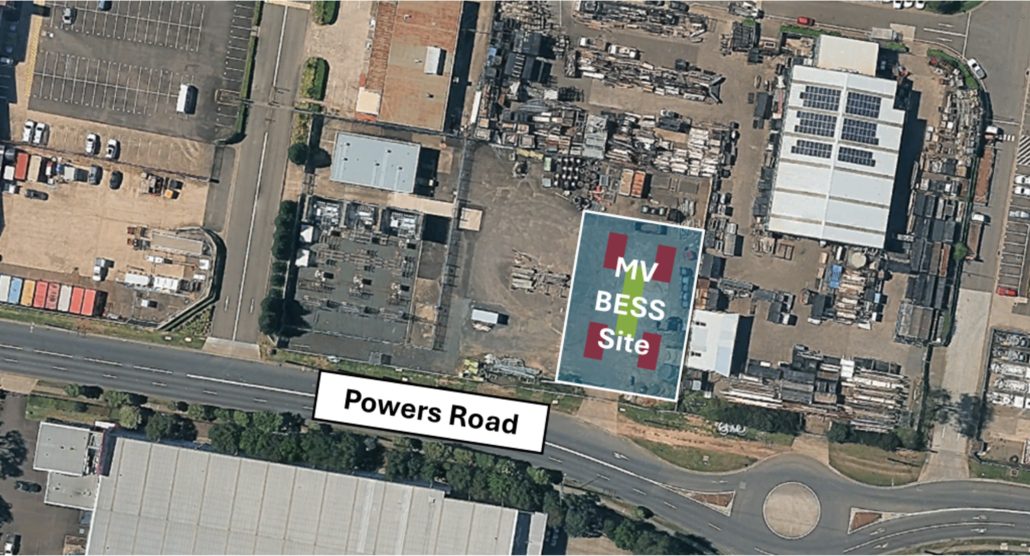
Proposed Battery Energy Storage System in Seven Hills
Ausconnex is proposing a small scale, medium voltage (MV) BESS which will be located on the site of the existing transmission substation at 22 Powers Rd, Seven Hills NSW. See site map image below.
Building the BESS within the existing substation site uses land that is already set aside for this purpose and avoids the need for additional transmission lines, minimising environmental impact.
Upcoming site investigations in your area
The Ausconnex team has begun preliminary studies in your area. This includes using noise loggers (see photo) to measure background noise and assess noise sensitivity in the areas surrounding the proposed BESS.
You may see our team on-site as we carry out this important work. These investigations will not impact your electricity supply.
This work will continue over the coming weeks and the findings will help compare noise from equipment and activities during construction and operations and determine if noise mitigation measures are needed.
Have Your Say
As a valued community member, we invite you to ask questions or share your feedback on the proposed works. The Development Application (DA) will be lodged with Blacktown Council in the coming months.
Following this, Council will publicly notify surrounding landowners about the DA. We will continue to keep you updated throughout the project.
Please contact us at batteries@ausconnex.com.au or 1800 955 224 if you would like to make any comments on the proposed project at this stage.

Photo example of a noise logger used to measure background noise level
BESS stands for Battery Energy Storage System, as it consists of one or more batteries that store electrical energy for use at a later time. This stored energy can then be drawn upon as needed, to meet various demands for power.
The proposed BESS will provide localised energy supply, support the growing demand in energy resources, and;
- Provide reliable power supply to customers now and in the future;
- Improve service reliability and provide grid support by reducing the risk of power disruptions;
- Support the energy network benefiting customers and enabling improved grid resiliency and;
- Enhance the energy sustainability ecosystem by storing excess solar generation.
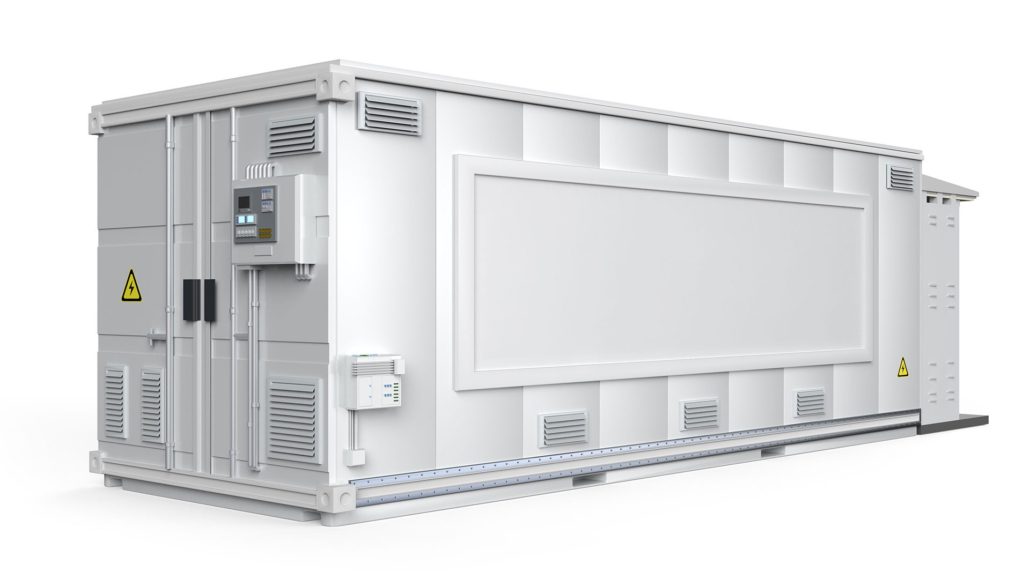
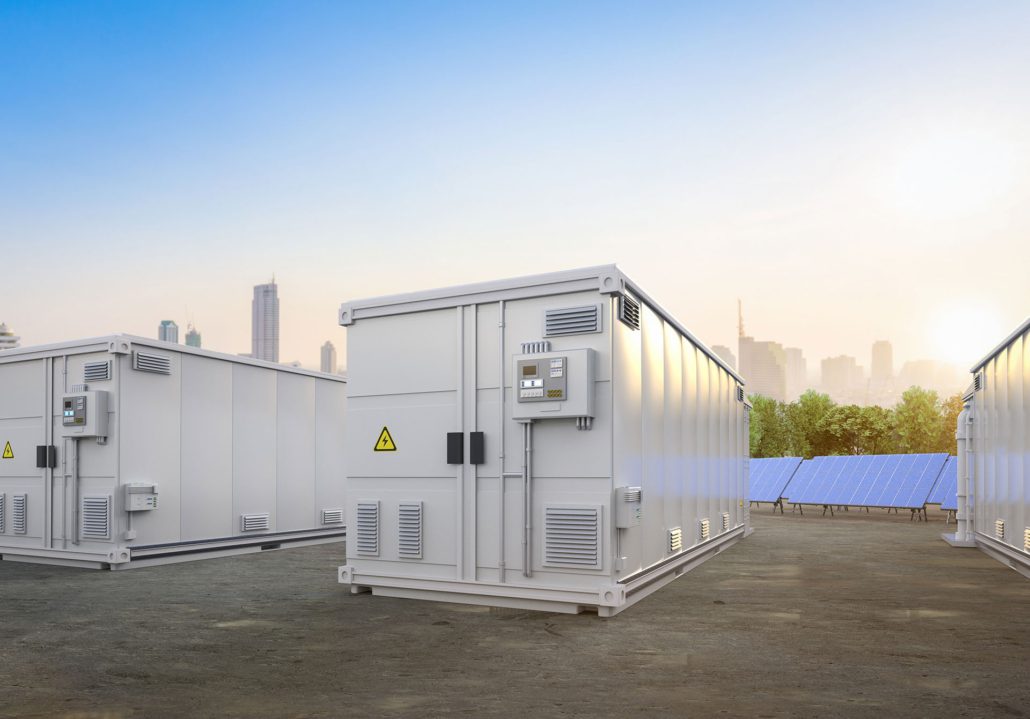
A BESS, which generally looks like a set of shipping containers that are about three metres high, is comprised of four key components:
- Battery packs – a set of modules that turn chemical energy into electricity, which, in turn, make up the battery pack.
- Battery management system – BMS: Which ensures the safety of the battery system by monitoring and measuring the condition of the modules.
- Inverter or power conversion system – PCS: Which shifts the direct current (DC) generated by the batteries to alternating current (AC) that goes into the electricity grid and vice versa, allowing for charging and discharging.
- Balance of Plant – BoP: Which is the electrical equipment enabling connecting the BESS to the grid including transformers, switchgear and cables.
- Grid reliability and stabilisation – the BESS can absorb or release electrical power almost instantly, providing valuable services in balancing power supply and demand.
- Renewable energy integration – a BESS can store excess energy generated from renewable sources like solar during periods of low demand and release it during peak demand times. Ensuring a continuous and reliable supply of renewable energy even when the sun isn’t shining.
- Flexibility to dispatch energy – During natural disasters or heat waves when the grid is under stress, the BESS will be able to provide grid support, enhancing resilience to ensure the power stays on.
- Cost efficiencies – by discharging stored energy during peak demand periods, the BESS can help reduce the need for expensive peaking power plants, leading to potential cost savings for consumers on their power bills.
- Environmental benefits – by integrating renewable energy more effectively and decreasing dependence on fossil fuel-based peaking plants, BESS contributes to lower carbon emissions and a cleaner environment.
What is a BESS?
A Battery Energy Storage System – BESS – is an advanced technology that captures, stores and distributes energy from both renewable energy such as solar and wind, and non-renewable sources, making it available when needed. It supports the electricity grid by providing a reliable, efficient power supply.
What are the benefits of a BESS?
- Delivers a reliable power supply
- Improves service reliability and delivers grid support by reducing the risk of power disruptions
- Enhances grid efficiency and provides support to the grid during peak demand
- Enhances energy sustainability by storing excess solar energy for use when it’s needed
Will the BESS generate an electric and magnetic field?
Electromagnetic Fields (EMF) are created whenever there is a difference in voltage (which forms electric fields) or when electricity flows through wires or devices (which forms magnetic fields). Construction of the BESS will follow strict Australian safety standards and guidelines, ensuring it operates safely and effectively. The EMF levels are expected to be very low and within safe limits.
What are the possible fire risks for grid-scale batteries?
The design and installation of the BESS will follow Australian safety standards and comply with the Work Health and Safety Regulation 2025. An advanced Battery Management System will ensure operation is within safe limits and will be supported by an array of sensors and fire suppression systems to reduce fire risks. Full scale fire testing will be completed to ensure adequate separation between the BESS and other infrastructure. Fire & Rescue NSW will be engaged as part of developing an appropriate emergency response plan to a fire.
How much noise will the BESS generate once operational?
Once the BESS is up and running, it will meet all industry noise standards. The sound you might hear will come from normal day-to-day operation and maintenance. We’ve undertaken a Noise and Vibration Assessment which includes recommendations to reduce noise, and we’ll put measures in place to reduce impacts to the community.
Will there be a lot of noise and dust during construction?
Construction will take place on weekdays from 7am to 6pm and on Saturdays from 8am to 1pm. We’re currently assessing the noise levels from equipment and activities during construction. If the assessment shows that noise reduction measures are needed, we’ll put measures in place to help minimise any impact in the area.
Will construction take place at night?
We’ll be working during regular hours (Monday to Friday from 7am to 6pm and Saturdays from 8am to 1pm) to build the BESS. During construction, we’ll keep noise levels down as much as possible.
Will there be heavy vehicle movements during construction?
Building the BESS will involve some heavy vehicle movements around the site. Other materials, plants, and equipment might also need heavy vehicles for delivery. Once operational, the BESS will need very little maintenance, so traffic impacts will be minimal. Before construction starts, a traffic assessment report and an application to Council will be needed if there are plans for road closures or pathway closures. During construction, traffic impacts will be managed with a Construction Environmental Management Plan (CEMP) or a Traffic Management Plan (TMP).
I have solar on my roof, how will the BESS affect my usage and what I give back to the grid?
If you have solar on your roof, any excess energy created will continue to feed back into the grid, which will include the medium voltage (MV) BESS at the Penrith Zone substation. The energy stored at the MV BESS will be used to discharge energy back into the network when demand is needed.
For more information, please contact us at:
Email: batteries@ausconnex.com.au or Phone: 1800 955 224
Acknowledgement of Country
 Ausconnex acknowledges the Traditional Custodians of country where we work – the people of the Dharug, Wiradjuri, Dharawal, Gundungarra and Yuin nations – and recognises their continuing connection to the land, waters and community. We pay our respect to them, their cultures, and to the Elders past, present and emerging.
Email: batteries@ausconnex.com.au
Phone: 1800 955 224.
ABN: 39 232 846 628